📋 Model Description
library_name: transformers license: apache-2.0 license_link: https://huggingface.co/Qwen/Qwen3-Next-80B-A3B-Thinking/blob/main/LICENSE pipeline_tag: text-generation
Qwen3-Next-80B-A3B-Thinking-GGUF

Over the past few months, we have observed increasingly clear trends toward scaling both total parameters and context lengths in the pursuit of more powerful and agentic artificial intelligence (AI).
We are excited to share our latest advancements in addressing these demands, centered on improving scaling efficiency through innovative model architecture.
We call this next-generation foundation models Qwen3-Next.
Highlights
Qwen3-Next-80B-A3B is the first installment in the Qwen3-Next series and features the following key enchancements:
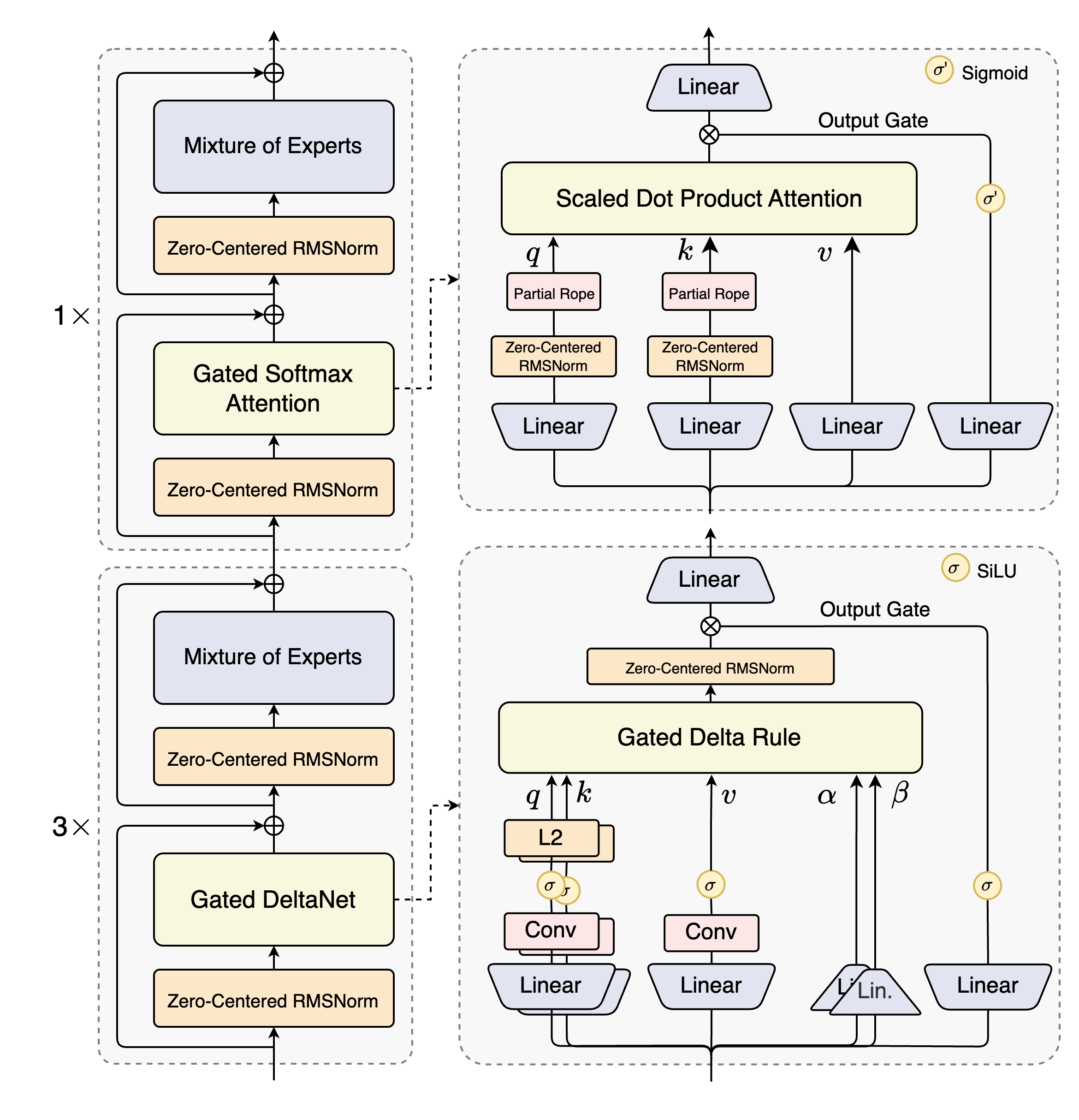
- Hybrid Attention: Replaces standard attention with the combination of Gated DeltaNet and Gated Attention, enabling efficient context modeling for ultra-long context length.
- High-Sparsity Mixture-of-Experts (MoE): Achieves an extreme low activation ratio in MoE layers, drastically reducing FLOPs per token while preserving model capacity.
- Stability Optimizations: Includes techniques such as zero-centered and weight-decayed layernorm, and other stabilizing enhancements for robust pre-training and post-training.
- Multi-Token Prediction (MTP): Boosts pretraining model performance and accelerates inference.
We are seeing strong performance in terms of both parameter efficiency and inference speed for Qwen3-Next-80B-A3B:
- Qwen3-Next-80B-A3B-Base outperforms Qwen3-32B-Base on downstream tasks with 10% of the total training cost and with 10 times inference throughput for context over 32K tokens.
- Leveraging GSPO, we have addressed the stability and efficiency challenges posed by the hybrid attention mechanism combined with a high-sparsity MoE architecture in RL training.
Qwen3-Next-80B-A3B-Thinking demonstrates outstanding performance on complex reasoning tasks, not only surpassing Qwen3-30B-A3B-Thinking-2507 and Qwen3-32B-Thinking, but also outperforming the proprietary model Gemini-2.5-Flash-Thinking across multiple benchmarks.
!Qwen3-Next-80B-A3B-Thinking Benchmark Comparison
For more details, please refer to our blog post Qwen3-Next.
Model Overview
[!Note]
Qwen3-Next-80B-A3B-Thinking supports only thinking mode.
To enforce model thinking, the default chat template automatically includes
.Therefore, it is normal for the model's output to contain only
without an explicit openingtag.[!Note]
Qwen3-Next-80B-A3B-Thinking may generate thinking content longer than its predecessor.
We strongly recommend its use in highly complex reasoning tasks.
Qwen3-Next-80B-A3B-Thinking has the following features:
- Type: Causal Language Models
- Training Stage: Pretraining (15T tokens) & Post-training
- Number of Parameters: 80B in total and 3B activated
- Number of Paramaters (Non-Embedding): 79B
- Hidden Dimension: 2048
- Number of Layers: 48
- Hybrid Layout: 12 \ (3 \ (Gated DeltaNet -> MoE) -> 1 \* (Gated Attention -> MoE))
- Gated Attention:
- Number of Attention Heads: 16 for Q and 2 for KV
- Head Dimension: 256
- Rotary Position Embedding Dimension: 64
- Gated DeltaNet:
- Number of Linear Attention Heads: 32 for V and 16 for QK
- Head Dimension: 128
- Mixture of Experts:
- Number of Experts: 512
- Number of Activated Experts: 10
- Number of Shared Experts: 1
- Expert Intermediate Dimension: 512
- Context Length: 262,144 natively and extensible up to 1,010,000 tokens
Performance
| Qwen3-30B-A3B-Thinking-2507 | Qwen3-32B Thinking | Qwen3-235B-A22B-Thinking-2507 | Gemini-2.5-Flash Thinking | Qwen3-Next-80B-A3B-Thinking | |
|---|---|---|---|---|---|
| Knowledge | |||||
| MMLU-Pro | 80.9 | 79.1 | 84.4 | 81.9 | 82.7 |
| MMLU-Redux | 91.4 | 90.9 | 93.8 | 92.1 | 92.5 |
| GPQA | 73.4 | 68.4 | 81.1 | 82.8 | 77.2 |
| SuperGPQA | 56.8 | 54.1 | 64.9 | 57.8 | 60.8 |
| Reasoning | |||||
| AIME25 | 85.0 | 72.9 | 92.3 | 72.0 | 87.8 |
| HMMT25 | 71.4 | 51.5 | 83.9 | 64.2 | 73.9 |
| LiveBench 241125 | 76.8 | 74.9 | 78.4 | 74.3 | 76.6 |
| Coding | |||||
| LiveCodeBench v6 (25.02-25.05) | 66.0 | 60.6 | 74.1 | 61.2 | 68.7 |
| CFEval | 2044 | 1986 | 2134 | 1995 | 2071 |
| OJBench | 25.1 | 24.1 | 32.5 | 23.5 | 29.7 |
| Alignment | |||||
| IFEval | 88.9 | 85.0 | 87.8 | 89.8 | 88.9 |
| Arena-Hard v2* | 56.0 | 48.4 | 79.7 | 56.7 | 62.3 |
| WritingBench | 85.0 | 79.0 | 88.3 | 83.9 | 84.6 |
| Agent | |||||
| BFCL-v3 | 72.4 | 70.3 | 71.9 | 68.6 | 72.0 |
| TAU1-Retail | 67.8 | 52.8 | 67.8 | 65.2 | 69.6 |
| TAU1-Airline | 48.0 | 29.0 | 46.0 | 54.0 | 49.0 |
| TAU2-Retail | 58.8 | 49.7 | 71.9 | 66.7 | 67.8 |
| TAU2-Airline | 58.0 | 45.5 | 58.0 | 52.0 | 60.5 |
| TAU2-Telecom | 26.3 | 27.2 | 45.6 | 31.6 | 43.9 |
| Multilingualism | |||||
| MultiIF | 76.4 | 73.0 | 80.6 | 74.4 | 77.8 |
| MMLU-ProX | 76.4 | 74.6 | 81.0 | 80.2 | 78.7 |
| INCLUDE | 74.4 | 73.7 | 81.0 | 83.9 | 78.9 |
| PolyMATH | 52.6 | 47.4 | 60.1 | 49.8 | 56.3 |
Quickstart
llama.cpp
Check out our llama.cpp documentation for more usage guide.
We advise you to clone llama.cpp and install it following the official guide. We follow the latest version of llama.cpp.
In the following demonstration, we assume that you are running commands under the repository llama.cpp.
./llama-cli -hf Qwen/Qwen3-Next-80B-A3B-Thinking-GGUF:Q8_0 --jinja --color -ngl 99 -fa on -sm row --temp 0.6 --top-k 20 --top-p 0.95 --min-p 0 --presence-penalty 1.5 -c 262144 -n 256000 --no-context-shiftProcessing Long Texts
Qwen3 natively supports context lengths of up to 262,144 tokens. For conversations where the total length (including both input and output) significantly exceeds this limit, we recommend using RoPE scaling techniques to handle long texts effectively. We have validated the model's performance on context lengths of up to 131,072 tokens using the YaRN method.
To enable YARN in `llama.cpp:
./llama-cli ... -c 1010000 --rope-scaling yarn --rope-scale 4 --yarn-orig-ctx 262144Agentic Use
Qwen3 excels in tool calling capabilities. We recommend using Qwen-Agent to make the best use of agentic ability of Qwen3. Qwen-Agent encapsulates tool-calling templates and tool-calling parsers internally, greatly reducing coding complexity.
To define the available tools, you can use the MCP configuration file, use the integrated tool of Qwen-Agent, or integrate other tools by yourself.
from qwen_agent.agents import Assistantvllm serve Qwen/Qwen3-Next-80B-A3B-Thinking --served-model-name Qwen3-Next-80B-A3B-Thinking --port 8000 --tensor-parallel-size 4 --max-model-len 262144Define LLM
Using Alibaba Cloud Model Studio
llm_cfg = { 'model': 'Qwen3-Next-80B-A3B-Thinking', 'modeltype': 'qwendashscope', }Using OpenAI-compatible API endpoint. It is recommended to disable the reasoning and the tool call parsing
functionality of the deployment frameworks and let Qwen-Agent automate the related operations. For example,
. #llm_cfg = {
'model': 'Qwen3-Next-80B-A3B-Thinking',
## Use a custom endpoint compatible with OpenAI API:
'modelserver': 'http://localhost:8000/v1', # apibase without reasoning and tool call parsing
'api_key': 'EMPTY',
'generate_cfg': {
'thoughtincontent': True,
},
}
Define Tools
tools = [ {'mcpServers': { # You can specify the MCP configuration file 'time': { 'command': 'uvx', 'args': ['mcp-server-time', '--local-timezone=Asia/Shanghai'] }, "fetch": { "command": "uvx", "args": ["mcp-server-fetch"] } } }, 'code_interpreter', # Built-in tools ]Define Agent
bot = Assistant(llm=llmcfg, functionlist=tools)Streaming generation
messages = [{'role': 'user', 'content': 'https://qwenlm.github.io/blog/ Introduce the latest developments of Qwen'}] for responses in bot.run(messages=messages): pass print(responses)
Processing Ultra-Long Texts
Qwen3-Next natively supports context lengths of up to 262,144 tokens.
For conversations where the total length (including both input and output) significantly exceeds this limit, we recommend using RoPE scaling techniques to handle long texts effectively.
We have validated the model's performance on context lengths of up to 1 million tokens using the YaRN method.
YaRN is currently supported by several inference frameworks, e.g., transformers, vllm and sglang.
In general, there are two approaches to enabling YaRN for supported frameworks:
- Modifying the model files:
file, add the rope_scaling fields:
{
...,
"rope_scaling": {
"rope_type": "yarn",
"factor": 4.0,
"originalmaxposition_embeddings": 262144
}
}
- Passing command line arguments:
For
vllm, you can use
VLLMALLOWLONGMAXMODELLEN=1 vllm serve ... --rope-scaling '{"ropetype":"yarn","factor":4.0,"originalmaxposition_embeddings":262144}' --max-model-len 1010000
For
sglang, you can use
SGLANGALLOWOVERWRITELONGERCONTEXTLEN=1 python -m sglang.launchserver ... --json-model-override-args '{"ropescaling":{"ropetype":"yarn","factor":4.0,"originalmaxposition_embeddings":262144}}' --context-length 1010000
[!NOTE]
All the notable open-source frameworks implement static YaRN, which means the scaling factor remains constant regardless of input length, potentially impacting performance on shorter texts.
We advise adding the
rope_scaling configuration only when processing long contexts is required. It is also recommended to modify the
factor as needed. For example, if the typical context length for your application is 524,288 tokens, it would be better to set factor as 2.0.
Best Practices
To achieve optimal performance, we recommend the following settings:
- Sampling Parameters:
- We suggest using Temperature=0.6, TopP=0.95, TopK=20, and MinP=0.
- For supported frameworks, you can adjust the presence_penalty parameter between 0 and 2 to reduce endless repetitions. However, using a higher value may occasionally result in language mixing and a slight decrease in model performance.
- Adequate Output Length: We recommend using an output length of 32,768 tokens for most queries. For benchmarking on highly complex problems, such as those found in math and programming competitions, we suggest setting the max output length to 81,920 tokens. This provides the model with sufficient space to generate detailed and comprehensive responses, thereby enhancing its overall performance.
- Standardize Output Format: We recommend using prompts to standardize model outputs when benchmarking.
- Math Problems: Include "Please reason step by step, and put your final answer within \boxed{}." in the prompt.
- Multiple-Choice Questions: Add the following JSON structure to the prompt to standardize responses: "Please show your choice in the answer field with only the choice letter, e.g., "answer": "C"`."
- No Thinking Content in History: In multi-turn conversations, the historical model output should only include the final output part and does not need to include the thinking content. It is implemented in the provided chat template in Jinja2. However, for frameworks that do not directly use the Jinja2 chat template, it is up to the developers to ensure that the best practice is followed.
Citation
If you find our work helpful, feel free to give us a cite.
@misc{qwen3technicalreport,
      title={Qwen3 Technical Report},
      author={Qwen Team},
      year={2025},
      eprint={2505.09388},
      archivePrefix={arXiv},
      primaryClass={cs.CL},
      url={https://arxiv.org/abs/2505.09388},
}

@article{qwen2.5-1m,
      title={Qwen2.5-1M Technical Report},
      author={An Yang and Bowen Yu and Chengyuan Li and Dayiheng Liu and Fei Huang and Haoyan Huang and Jiandong Jiang and Jianhong Tu and Jianwei Zhang and Jingren Zhou and Junyang Lin and Kai Dang and Kexin Yang and Le Yu and Mei Li and Minmin Sun and Qin Zhu and Rui Men and Tao He and Weijia Xu and Wenbiao Yin and Wenyuan Yu and Xiafei Qiu and Xingzhang Ren and Xinlong Yang and Yong Li and Zhiying Xu and Zipeng Zhang},
      journal={arXiv preprint arXiv:2501.15383},
      year={2025}
}
📂 GGUF File List
| 📁 Filename | 📦 Size | ⚡ Download |
|---|---|---|
|
Qwen3-Next-80B-A3B-Thinking-00001-of-00004.gguf
LFS
|
45.66 GB | Download |
|
Qwen3-Next-80B-A3B-Thinking-00002-of-00004.gguf
LFS
|
46.4 GB | Download |
|
Qwen3-Next-80B-A3B-Thinking-00003-of-00004.gguf
LFS
|
46.29 GB | Download |
|
Qwen3-Next-80B-A3B-Thinking-00004-of-00004.gguf
LFS
|
10.15 GB | Download |
|
Qwen3-Next-80B-A3B-Thinking-Q4_K_M.gguf
Recommended
LFS
Q4
|
45.09 GB | Download |
|
Qwen3-Next-80B-A3B-Thinking-Q5_0.gguf
LFS
Q5
|
51.22 GB | Download |
|
Qwen3-Next-80B-A3B-Thinking-Q5_K_M.gguf
LFS
Q5
|
52.82 GB | Download |
|
Qwen3-Next-80B-A3B-Thinking-Q6_K.gguf
LFS
Q6
|
61.03 GB | Download |
|
Qwen3-Next-80B-A3B-Thinking-Q8_0.gguf
LFS
Q8
|
78.99 GB | Download |